
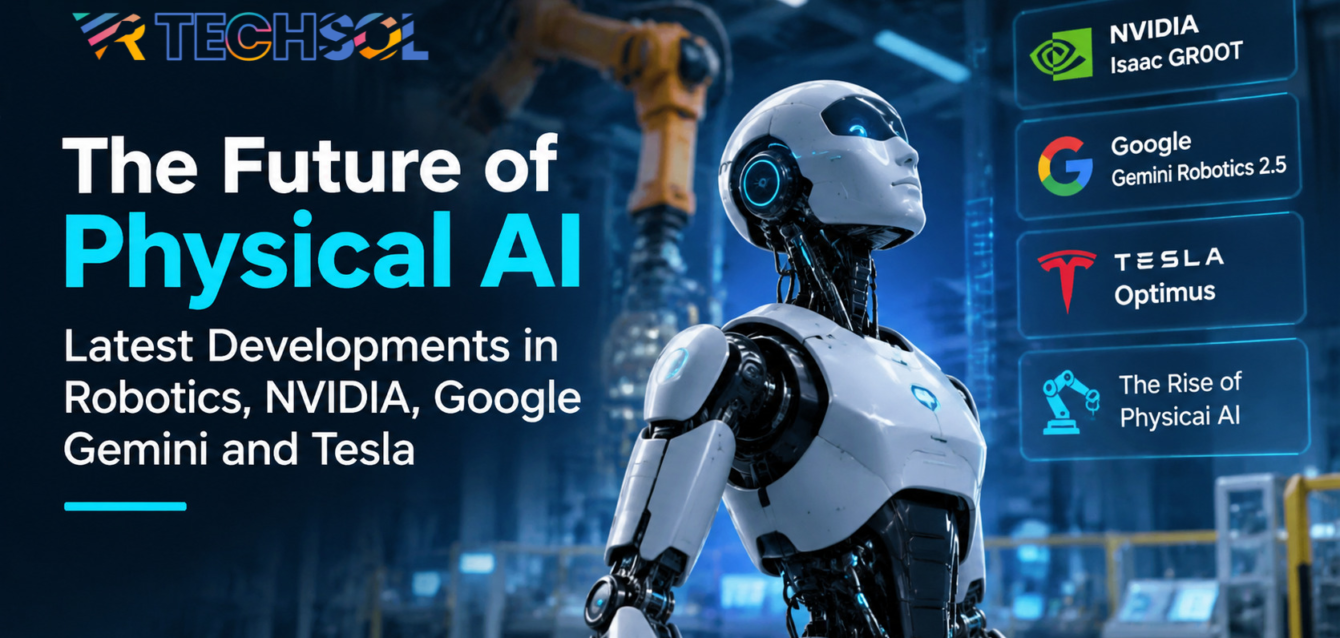
Artificial Intelligence is moving beyond chatbots, virtual assistants and software applications. A new generation of AI technology is enabling machines to understand their surroundings, make decisions and interact with the physical world.
This development is known as Physical AI.
From NVIDIA’s humanoid robotics platforms and Google’s Gemini Robotics models to Tesla’s Optimus programme, major technology companies are investing in intelligent machines that can perform increasingly complex physical tasks. Robots are no longer limited to following fixed instructions in controlled environments. Advances in computer vision, machine learning, robotics foundation models and simulation are helping them become more adaptable.
But what is actually changing, which companies are leading this development, and how could Physical AI transform businesses?
Let’s explore the latest developments and what they mean for the future of robotics.
1. What Is Physical AI?
Physical AI refers to artificial intelligence systems that can perceive, understand and interact with the physical world. Traditional AI primarily operates within digital environments. It processes text, images, documents and other information to generate responses or complete software-based tasks.
Physical AI takes this intelligence into physical environments by combining AI models with:
- Robotics and mechanical systems.
- Computer vision and image recognition.
- Cameras, sensors and environmental data.
- Machine learning and reasoning models.
- Motion planning and robotic control systems.
- Simulation and digital twin technologies.
For example, a traditional AI assistant can explain how to organise a warehouse. A Physical AI-powered robot could potentially identify objects, navigate the warehouse, pick up items and move them to designated locations.
The important difference is the ability to connect intelligence with physical action.
Physical AI is not limited to humanoid robots. It also includes industrial robotic arms, autonomous vehicles, warehouse robots, drones and intelligent machines operating in real-world environments.
2. NVIDIA: Building the Software Foundation for Intelligent Robots
NVIDIA is playing a major role in the development of Physical AI by providing the computing infrastructure, simulation environments and AI models needed to develop intelligent robotic systems. Its robotics ecosystem includes NVIDIA Isaac, Isaac GR00T, Isaac Lab and simulation technologies designed to help developers train, test and deploy robots.
NVIDIA Isaac GR00T: Teaching Humanoid Robots New Skills
NVIDIA Isaac GR00T is a family of foundation models and development tools designed for humanoid robotics. Rather than programming every movement individually, developers can use these models and workflows to help robots learn skills through demonstrations, training data and simulation.
In November 2026, NVIDIA introduced GR00T 2, a world action model designed to improve how robots understand their surroundings, predict the effects of their actions and perform complex physical tasks. NVIDIA reported that GR00T 2 completed 40 of 50 evaluated tasks at least once without task-specific demonstrations. It also reported average success rates of 71% with one demonstration per task and 95% with five demonstrations. These developments demonstrate progress towards robots that can learn and transfer skills across different environments.
NVIDIA Isaac Lab: Training Robots Through Simulation
Training physical robots entirely in real-world environments can be expensive and time-consuming. This is where simulation becomes important. NVIDIA Isaac Lab provides a framework for robot learning, simulation and evaluation. Developers can create virtual environments, test robot behaviours and refine their models before deploying them on physical hardware. This approach can help reduce development time and improve the testing process. NVIDIA’s broader Isaac ecosystem is designed to connect robot simulation, training, evaluation and deployment.
Why this matters: The future of robotics depends not only on the physical machines but also on the software infrastructure that allows developers to train, test and improve them.
3. Google DeepMind: Gemini Robotics 2.5 and Vision-Language-Action Models
Google DeepMind is advancing Physical AI through its Gemini Robotics models. One important development is the use of Vision-Language-Action (VLA) models.
A VLA model connects three capabilities:
- Vision: Understanding objects, environments and visual information.
- Language: Interpreting human instructions and understanding tasks.
- Action: Translating that understanding into physical robot movements.
This allows robots to connect human instructions with physical actions.
What Is New in Gemini Robotics 2.5?
On 10 November 2026, Google DeepMind introduced Gemini Robotics 2.5, describing it as its most capable Vision-Language-Action model to date. The model focuses on improving three important areas:
1. Greater Dexterity
Robots can learn a broader range of physical tasks, including handling delicate and flexible objects and using everyday tools.
2. Improved Reliability
Google reported that Gemini Robotics 2.5 improved task success rates by 30% to 100%, depending on the task and comparison baseline, while completing tasks 20% to 30% faster.
3. Improved Physical Safety
The model introduces additional safety capabilities to help robots navigate obstacles and operate more safely around people.
Real-World Example: Mercedes-Benz Manufacturing
One particularly interesting demonstration involved Apptronik’s Apollo 2 humanoid robot on Mercedes-Benz production lines. Using Gemini Robotics models, the robot performed automotive kitting, which involves sorting individual components into organised trays for vehicle assembly.
Google reported a 96% success rate in this proof-of-concept.
This is an important example of how Physical AI could support repetitive industrial work while allowing human technicians to focus on more complex tasks. The model is rolling out to Google’s robotics partners, rather than being a general consumer robotics product.
4. Tesla Optimus: The Rise of Humanoid Robots
Tesla is developing Optimus, its humanoid robot programme aimed at performing physical tasks in human environments.
The concept is to develop a general-purpose robot capable of handling repetitive, physically demanding and potentially dangerous activities. Unlike conventional industrial robots that typically operate in carefully controlled environments, humanoid robots are designed around a form factor that can potentially work in spaces built for people.
What Could Tesla Optimus Do?
Potential applications include:
- Moving materials and equipment.
- Handling repetitive manufacturing tasks.
- Transporting objects within facilities.
- Supporting warehouse operations.
- Performing selected household activities in the future.
Tesla’s Q1 2026 update described preparations for its first large-scale Optimus factory in Fremont and a second-generation production line planned for Texas. These are manufacturing plans and capacity targets, not evidence that the proposed production volumes have already been achieved. The wider opportunity is significant: humanoid robots could eventually perform tasks across multiple environments without requiring every workplace to be redesigned around specialised machinery.
However, reliability, dexterity, safety, production costs and practical deployment remain important challenges.
5. Other Robotics Companies to Watch
Although NVIDIA, Google and Tesla attract significant attention, several other companies are contributing to Physical AI development.
- Figure AI
Figure AI is developing general-purpose humanoid robots and AI systems designed to perform physical tasks in homes and industrial environments. Its Helix platform focuses on combining visual understanding, language and robotic control. In September 2026, Figure announced Helix 2.5 and reported zero-shot generalisation across 30 homes, highlighting progress in adapting robot behaviours to different domestic environments.
- Boston Dynamics
Boston Dynamics is known for its advanced robotics research and development. Its Atlas humanoid robot demonstrates progress in robotic movement, balance, manipulation and physical interaction. The company’s work illustrates how mechanical engineering, control systems and AI can combine to produce increasingly capable robots.
- Physical Intelligence
Physical Intelligence is developing general-purpose robotic intelligence through foundation models designed to help robots perform different tasks across different robotic platforms. Its research is particularly relevant to the development of adaptable robotic systems rather than machines designed for only one narrowly defined task.
- 1X Technologies
1X Technologies is developing humanoid robots, including its NEO platform, with a focus on practical assistance in human environments. Its work reflects the growing interest in bringing general-purpose robotics into everyday settings.
The bigger picture: Robotics innovation is no longer coming from a single company or technology. It is developing through an ecosystem of AI researchers, hardware manufacturers, software developers and industrial partners.
6. Where Will Physical AI Be Used?
The impact of Physical AI could extend across several industries.
- Manufacturing and Industrial Automation
Factories could use intelligent robots to handle materials, inspect components, perform repetitive assembly tasks and support production workflows. AI-powered computer vision could also help identify defects and improve quality inspection.
- Healthcare and Hospitals
Robotics could support hospital logistics, equipment transportation, selected repetitive tasks and assistance with physical operations. Clinical applications require particularly strong safety, reliability and regulatory controls.
- Warehousing and Logistics
Physical AI could improve warehouse operations through intelligent picking, sorting, inventory movement and autonomous navigation. Robots that can adapt to changing warehouse layouts could offer greater flexibility than conventional fixed automation.
- Smart Homes and Household Automation
Humanoid robots and intelligent home systems could eventually assist with household tasks, object handling, cleaning and everyday activities. However, general-purpose household robotics is still developing. Many of these applications remain future possibilities rather than widely available consumer capabilities.
Robotics could support material handling, site inspection, repetitive physical work and equipment monitoring. For field-service businesses, AI-enabled systems could also connect equipment data, service information and operational workflows.
7. What Makes Physical AI Possible? The Software Behind the Robot
A humanoid robot may attract attention, but its intelligence depends on several connected technologies.
- AI Foundation Models
These models help robots understand instructions, recognise objects, interpret situations and plan tasks.
- Computer Vision
Computer vision enables robots to interpret images and video, identify objects and understand their surroundings.
- Sensors and Data Processing
Cameras, depth sensors, lidar and other sensors provide information about the robot’s environment.
- Robotics Software and Control Systems
Robotics software translates decisions into physical movements while managing balance, positioning and coordination.
- Simulation and Digital Twins
Virtual environments allow developers to train and evaluate robotic systems before testing them in the real world.
- Software Integration
Robots may need to communicate with enterprise applications, inventory systems, manufacturing platforms, monitoring tools and other operational software.
The real opportunity lies in bringing these technologies together into a system that can operate reliably.
8. Challenges: What Is Holding Physical AI Back?
Despite rapid progress, Physical AI is not yet ready to replace human workers across every environment.
Several challenges remain.
- Reliability: Robots must perform consistently in environments that can change unexpectedly.
- Safety: Physical systems need safeguards to prevent injuries, equipment damage and unsafe decisions.
- Training Data: Developing capable robots requires large amounts of diverse real-world and simulated training data.
- Deployment Costs: Hardware, computing infrastructure, maintenance and integration can make implementation expensive.
- Real-World Adaptability: A robot that performs well in a controlled demonstration may struggle with unfamiliar objects, layouts or environmental conditions.
- Human Oversight: Businesses need clear processes for supervision, intervention and accountability.
The next stage of development will depend on solving these practical challenges, not just increasing model intelligence.
9. What Does the Future of Physical AI Look Like in 2027?
As we move into 2027, Physical AI is likely to remain one of the most important areas of artificial intelligence development.
Several trends deserve attention:
- More capable Vision-Language-Action models.
- Improved humanoid robot dexterity and task learning.
- Greater use of simulation and synthetic training data.
- Better integration between AI models and robotic hardware.
- Increased adoption of robotics in manufacturing and logistics.
- More focus on physical safety, reliability and operational governance.
The biggest development may not be a single humanoid robot. It could be the emergence of complete AI-powered systems that combine perception, reasoning, physical movement, software integration and human supervision. Businesses that understand these technologies early will be better positioned to identify practical opportunities as the technology matures.
10. How VRTECHSOL Fits Into the Future of AI and Robotics
The development of intelligent robots requires more than advanced hardware. It also requires software applications, AI integration, data management, intelligent workflows and systems that connect different technologies. At VRTECHSOL, we focus on building AI-powered software solutions that help businesses adopt emerging technologies and improve their operations.
Our capabilities include:
- AI agent development and intelligent automation.
- Custom AI-powered applications.
- Computer vision and AI integration.
- CRM and enterprise system integrations.
- Workflow automation using n8n and Make.
- Custom SaaS and software development.
As Physical AI evolves, the software layer will remain essential to connecting intelligent models, business applications and operational systems. Whether a business is exploring AI-powered applications today or evaluating future robotics integrations, having the right software architecture and integration strategy is an important starting point.
Explore how VRTECHSOL can support your AI development initiatives: https://vrtechsol.com/
Conclusion: The Future Is Physical AI
Artificial Intelligence is entering a new phase. These developments point towards a future in which AI will not only generate information but also interact with the physical world. The journey is still underway. Reliability, safety, cost and real-world adaptability will determine how quickly these technologies become part of everyday operations.
One thing is clear: the future of AI will not exist only on our screens. It will increasingly interact with the world around us.