
The HVAC and home services industry is changing. Customers expect faster responses, convenient scheduling, accurate estimates, and reliable service. Whether someone needs emergency air conditioning repair, plumbing assistance, electrical work, or routine maintenance, they want a company that can respond quickly and make the process simple.
For many contractors, meeting these expectations while managing technicians, incoming calls, service appointments, estimates, and customer follow-ups is becoming increasingly challenging.
This is where Artificial Intelligence (AI) is making a difference.
AI is no longer just a technology for large enterprises or software companies. Today, HVAC contractors, plumbers, electricians, and other home service providers can use AI to automate repetitive tasks, improve customer communication, and manage daily operations more efficiently.
The question is no longer whether AI has a place in the home services industry. It is how businesses can use it to stay competitive and deliver a better customer experience.
1. Never Miss a Potential Customer Because of a Busy Phone Line
For HVAC and home service companies, every incoming call could represent a new service appointment, an emergency repair, or a valuable long-term customer.
However, technicians may be on-site, office staff may be occupied, and calls may arrive after business hours. When customers cannot reach a company, they may simply call a competitor.
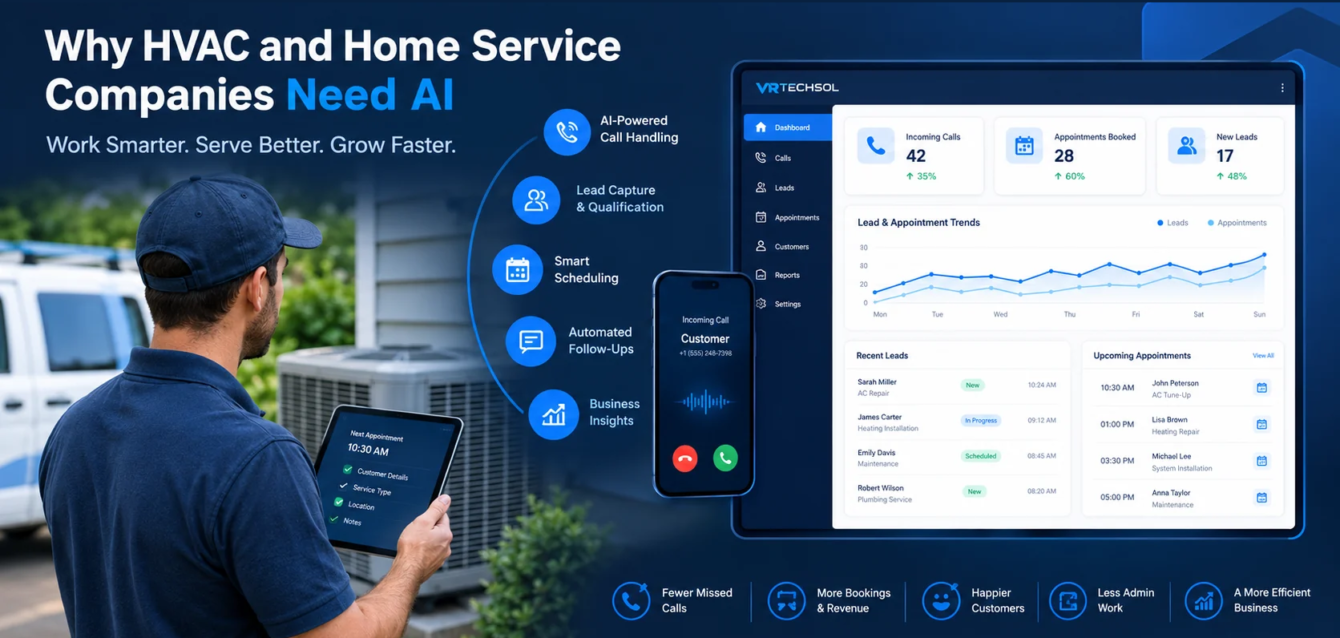
AI-powered voice agents can help address this problem by answering incoming calls, collecting customer details, understanding service requirements, and directing inquiries to the appropriate team. Depending on the system’s integrations and permissions, they can also help schedule appointments or record service requests.
Instead of relying entirely on someone being available to answer every call, businesses can create a more consistent communication process.
The business benefit: Fewer missed opportunities, more responsive customer service, and better handling of inquiries outside regular business hours.
2. Automate Appointment Scheduling and Customer Follow-Ups
Managing appointments can quickly become complicated when multiple technicians are working across different locations.
Office teams may spend hours confirming bookings, rescheduling visits, sending reminders, and responding to customers asking about appointment times.
AI-powered automation can reduce much of this administrative workload.
For example, a connected system can:
- Send automatic appointment confirmations and reminders.
- Notify customers about scheduling changes.
- Collect information before a technician arrives.
- Route service requests to the appropriate team.
- Follow up with customers after a completed job.
- Remind customers when routine maintenance is due.
When integrated with scheduling and customer management software, these workflows can operate with less manual intervention.
The business benefit: Less administrative work, fewer missed appointments, and more time for employees to focus on customers and essential business operations.
3. Respond to Leads Before They Choose a Competitor
Generating leads through websites, Google searches, social media, and advertising is only part of the sales process. What happens after a potential customer submits an inquiry is equally important.
A homeowner requesting an HVAC installation estimate may contact several contractors. If one company responds promptly while another takes hours or days, the faster company may have an advantage.
AI can help businesses respond to new inquiries, ask relevant qualifying questions, collect project details, and route promising opportunities to the sales team.
It can also support follow-up sequences for customers who requested estimates but have not yet made a decision.
For example, when a customer submits a request for a new air conditioning system, an automated workflow could acknowledge the inquiry, gather information about the property and service requirements, and notify the appropriate team member.
Human staff can then focus on consultations, technical assessments, and closing the sale.
The business benefit: Faster lead response, more consistent follow-ups, and fewer opportunities lost because of disorganized communication.
4. Improve Estimates and Quotation Follow-Ups
Preparing estimates and following up on outstanding quotations are essential parts of running a home service business.
Yet these tasks often compete with urgent customer requests and daily operational responsibilities.
AI can help organize customer information, prepare draft communications, summarize job requirements, and trigger reminders when an estimate has not received a response.
For instance, after an HVAC contractor sends an installation quotation, an automated workflow could schedule a follow-up message and notify the sales representative if the customer replies with a question.
AI can also assist with organizing historical job information and identifying patterns in estimates, provided the necessary data is available.
However, pricing, equipment selection, labor costs, and technical recommendations should remain subject to appropriate human review.
The business benefit: A more organized sales process, improved visibility into outstanding estimates, and fewer follow-ups forgotten during busy periods.
5. Make Better Decisions With Business Data
Many HVAC and home service businesses collect valuable information through their CRM, accounting software, booking systems, call records, and job management platforms.
The challenge is turning that information into useful decisions.
AI-powered analytics can help business owners identify patterns such as:
- Which marketing channels generate the most service inquiries.
- How quickly the team responds to new leads.
- Which services generate the most revenue.
- Where appointments are frequently delayed or cancelled.
- Which customers may be due for preventive maintenance.
- Where administrative bottlenecks affect daily operations.
With access to reliable, properly integrated data, AI can help transform scattered information into actionable insights.
Business owners can use these insights to improve scheduling, refine marketing campaigns, allocate resources, and identify areas that need attention.
The business benefit: Better operational visibility and more informed decisions based on actual business performance.
6. Reduce Repetitive Administrative Work Without Replacing Your Team
One common concern about AI is that it will replace employees. For many home service businesses, a more practical approach is to use AI to support existing staff.
Technicians should be able to focus on diagnosing equipment issues, completing repairs, and delivering quality workmanship. Office teams should have more time to resolve complex customer concerns, coordinate jobs, and support business growth.
Yet employees can lose valuable hours to repetitive activities such as entering customer information, sending routine updates, organizing service requests, and preparing basic reports.
AI automation can help reduce these tasks while keeping people involved where judgment, expertise, and personal communication matter most.
For example, AI can collect information during a customer call and prepare a summary for the office team. An employee can review the details, correct anything necessary, and decide what happens next.
The goal is not to remove the human element from home services. It is to give people better tools to do their jobs.
The business benefit: More productive employees, smoother workflows, and additional capacity to handle business growth without increasing administrative workload at the same pace.
7. Deliver a Better Customer Experience
Customer experience does not begin when a technician arrives at the property. It starts with the first phone call, website inquiry, or service request.
Customers want clear communication, realistic appointment expectations, timely updates, and an easy way to request assistance.
AI can support a more consistent experience by helping businesses acknowledge inquiries quickly, provide routine information, send reminders, and maintain organized customer records.
It can also help staff access relevant service history when the right systems are connected.
However, AI should not be expected to resolve every situation independently. Emergency calls, complex technical questions, complaints, and sensitive customer concerns may require immediate human attention.
The strongest approach combines automated convenience with a clear path to a real person.
The business benefit: More consistent communication, less customer frustration, and a service process designed around customer needs.
8. Stay Competitive as the Industry Becomes More Digital
Customers are becoming accustomed to convenient digital services across nearly every industry. Home services are no exception.
Businesses that make it easier to request appointments, receive updates, and communicate with service teams can create a stronger customer experience.
AI gives smaller and mid-sized contractors access to capabilities that previously required significant manual effort or larger administrative teams.
However, adopting AI does not mean purchasing every new tool available.
A company may benefit most from automating missed-call handling, while another may need better lead management, estimate follow-ups, or scheduling workflows.
The right starting point depends on the business’s current processes, customer expectations, software, and budget.
Companies that evaluate their operations now can make more informed decisions about where AI will provide practical value rather than adopting technology simply because it is trending.
How Should HVAC and Home Service Companies Get Started With AI?
Implementing AI does not have to mean transforming the entire business overnight.
A practical approach begins by identifying the operational problems that consume the most time or cause the greatest number of missed opportunities.
Step 1: Identify the bottleneck. Review incoming calls, response times, scheduling, lead follow-ups, estimates, and repetitive administrative tasks.
Step 2: Choose one high-value workflow. Start with a clearly defined problem, such as after-hours call handling or follow-ups for outstanding estimates.
Step 3: Connect the right systems. Where appropriate, integrate AI with existing phone systems, CRM platforms, calendars, booking tools, and job management software.
Step 4: Keep humans involved. Define when AI can act independently, when staff approval is required, and when a conversation must be transferred to a person.
Step 5: Measure the results. Track relevant metrics such as missed-call rates, response times, appointments booked, lead conversion, administrative hours, and customer satisfaction.
Step 6: Improve and expand. Use the results to refine the initial workflow before introducing additional automations.
Businesses should also consider customer privacy, secure access to business systems, accurate information, and compliance with applicable call-recording and communication requirements.
Starting small makes it easier to understand what works, control costs, and build confidence in the technology.
Why Choose VRTECHSOL for AI Automation?
At VRTECHSOL, we help businesses explore practical ways to apply AI and automation to their everyday operations.
For HVAC contractors and home service providers, this can include identifying opportunities to improve lead handling, automate repetitive administrative workflows, streamline customer communication, and connect existing business systems.
Our approach focuses on the business problem first and the technology second.
Rather than introducing unnecessary complexity, we work toward solutions that fit the company’s processes, existing tools, and operational goals.
Depending on business requirements, potential solutions may include:
- AI-powered voice agents for incoming customer inquiries.
- Automated lead capture and qualification.
- CRM integrations and follow-up workflows.
- Appointment reminders and scheduling automation.
- AI-assisted customer communication.
- Reporting and workflow improvements.
- Custom AI applications and integrations.
The objective is to help businesses spend less time on repetitive work and more time delivering services, supporting customers, and building stronger operations.
Final Thoughts: AI Is Becoming a Practical Business Advantage
Running an HVAC or home service company requires more than technical expertise. It also requires effective communication, consistent follow-ups, organized scheduling, and the ability to respond when customers need help.
When these processes depend entirely on manual effort, opportunities can be missed and administrative workloads can grow.
AI offers a practical way to address these challenges.
From answering calls and organizing leads to automating reminders and improving business reporting, the right AI workflows can help companies operate more efficiently while keeping their teams at the center of customer service.
You do not need to automate everything. You need to identify what is slowing your business down and determine where AI can make a measurable difference.
Ready to Explore AI for Your Home Service Business?
If missed calls, slow lead responses, repetitive administrative work, or inconsistent follow-ups are affecting your operations, it may be time to explore AI automation.
VRTECHSOL can help you identify the right opportunities and develop an approach aligned with your business needs.
Visit VRTECHSOL to learn more about our AI and software development services.
Let’s make your business more responsive, efficient, and ready for what’s next.