
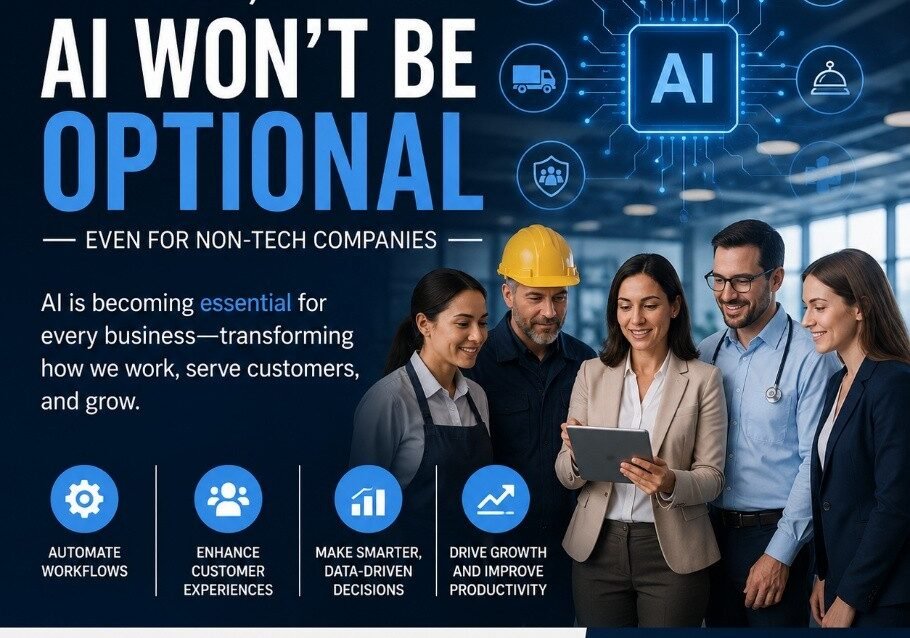
Artificial Intelligence has outgrown its old reputation as a tool for software companies and Silicon Valley giants. It’s now one of the most powerful business tools available, capable of automating processes, sharpening decision-making, and elevating customer experience.
By 2027, AI won’t be a nice to have. It will be table stakes. Just as email, the internet, and cloud computing reshaped how companies’ function, AI is on track to become a routine part of daily operations in every industry.
Whether you run a manufacturing plant, a restaurant, a law firm, an insurance agency, a retail store, a healthcare clinic, or a logistics company, the real question isn’t “Should we adopt AI?” It’s “How do we put AI to work for us?”
AI Is Becoming a Business Essential
Remember when companies first debated whether email was worth adopting? Plenty of businesses assumed their existing communication methods were good enough. Now, running a company without email is nearly unthinkable.
AI is following the same trajectory.
It’s no longer confined to chatbots or content generation. Today’s AI solutions help organizations simplify operations, cut down on manual work, sharpen customer service, and make faster decisions grounded in real data.
Companies adopting AI now are setting themselves up for the future. Those who hold off risk falling behind competitors who’ve already built automation and intelligent workflows into their operations.
Every Business Has Repetitive Work
A common misconception is that AI exists to replace employees. In truth, its purpose is to eliminate repetitive busy work, not human expertise.
Nearly every business loses hours each week to tasks like:
- Answering emails
- Scheduling appointments
- Processing invoices
- Managing documents
- Entering data
- Following up with leads
- Building reports
- Updating customer records
- Coordinating internal communications
- Handling routine customer questions
These tasks matter, but they rarely call for creativity or strategic thinking. Automating them frees employees to focus on solving problems, nurturing relationships, and driving innovation.
Customer Expectations Have Shifted
Customers today expect speed. They want:
- Immediate answers
- Personalized experiences
- Round-the-clock availability
- Fast service
- Accurate information
- Consistent communication
Meeting those expectations by hand gets harder as a business scales. That’s why AI-driven customer support, automated scheduling, virtual assistants, and personalized recommendations are quickly becoming the norm rather than the exception. Businesses that adopt these tools can meet rising customer demands while keeping costs in check.
AI Turns Data Into Better Decisions
Every organization sits on a mountain of data—sales figures, customer feedback, financial records, inventory numbers, marketing metrics, productivity stats. Most of it goes underused.
AI can sift through massive datasets in seconds, spotting patterns, forecasting trends, flagging risks, and surfacing opportunities that would otherwise stay hidden. Instead of leaning purely on gut instinct, leaders can make decisions backed by real-time insight. This is a major reason AI adoption is set to become essential by 2027.
AI Isn’t Just for Big Corporations Anymore
Advanced automation used to be the exclusive domain of multinational companies with deep IT budgets. That’s no longer true. AI tools are now affordable and accessible for businesses of every size.
Consider:
- Manufacturers predicting equipment failures before they occur
- Retailers fine-tuning inventory management
- Insurance agencies automating claims and customer inquiries
- Healthcare providers simplifying scheduling and patient communication
- Restaurants forecasting demand to cut food waste
- Professional service firms automating documentation and admin work
The playing field is already leveling out.
AI Enhances Employees, Doesn’t Replace Them
Job displacement is a real concern people have about AI. And while the nature of work will shift, AI’s biggest value comes from empowering employees, not sidelining them.
Picture:
- Sales reps spending more time closing deals instead of updating CRM entries
- HR teams focusing on employee development instead of manually sorting resumes
- Finance departments automating invoice processing and expense reconciliation
- Support teams tackling complex issues while AI handles the routine ones
AI’s real strength is freeing people to do the work that needs human judgment, empathy, creativity, and strategy.
Every Department Stands to Benefit
It’s a mistake to think AI only belongs in IT. Every function across a business can put it to use:
Human Resources: resume screening, onboarding, interview scheduling, policy assistance
Sales: lead qualification, proposal generation, CRM updates, forecasting
Marketing: content creation, campaign optimization, audience analysis, performance reporting
Operations: workflow automation, inventory forecasting, process optimization, quality assurance
Finance: invoice processing, expense management, fraud detection, financial forecasting
As AI tools grow more sophisticated and easier to integrate, the list of possibilities keeps expanding.
Waiting Could Cost More Than Adopting
History tends to repeat itself when it comes to major technology shifts. Businesses that delayed building websites eventually had to invest heavily to catch up. Companies that ignored mobile technology lost ground to more agile rivals.
AI is shaping up to be the next major shift. Organizations that delay adoption may face steeper costs, harder learning curves, and weaker competitive positioning down the road. Early adopters get to build expertise gradually while reaping operational benefits right away.
Start Small, Scale Smart
Adopting AI doesn’t require overhauling your entire business overnight. Many companies start with a single use case, such as:
- Automating customer support
- Streamlining document management
- Improving internal reporting
- Strengthening quality assurance
- Automating repetitive admin tasks
- Helping employees retrieve information faster
As teams grow more comfortable, businesses can expand AI’s role across other departments. The goal isn’t a sudden overhaul, it’s making everyday work faster, smarter, and more efficient over time.
The Future of Business Is AI-Enabled
By 2027, the conversation won’t be about whether to use AI, it’ll be about how to get the most out of it. Companies across manufacturing, healthcare, retail, hospitality, logistics, finance, insurance, education, and professional services are already weaving AI into their operations, not because it’s fashionable, but because it produces real results.
The businesses that thrive over the next decade won’t necessarily be tech companies. They’ll be the ones that use technology wisely.
Final Thoughts
AI isn’t replacing business, it’s reshaping how business gets done. The future favors organizations that embrace innovation, automate the repetitive, empower their people, and make smarter, data-driven decisions.
Whether you’re a startup, a growing company, or an established enterprise, AI is no longer optional. It’s becoming the foundation for long-term efficiency, competitiveness, and sustainable growth. By 2027, AI will feel as ordinary as email and cloud software do today, and the businesses that start now will be the ones leading their industries tomorrow.